


For overseas buyers entering the Vietnamese coffee market for the first time, knowing how to find coffee suppliers in vietnam is a practical starting point — but finding a name and a phone number is only the beginning. The more important challenge is identifying suppliers who match your specific product requirements, who are capable of exporting reliably, and who can be verified as legitimate business entities before you commit to a purchase. This page outlines a structured approach to finding and shortlisting coffee suppliers in Vietnam.

Step 1: Define Your Product Requirements Before Searching
Before searching for suppliers, a buyer needs to be clear about what they are sourcing. The Vietnamese coffee market includes Robusta and Arabica varieties, green beans, roasted coffee, ground coffee, instant coffee, and private label products. Suppliers specialise in different products and supply chain positions — some are processors who handle their own production; others are traders who aggregate from multiple sources. Knowing which product type you need, in what volume, with what packaging, and for which destination market narrows the field considerably before the first contact is made.
A written requirement document — even a simple one-page specification covering product type, quantity, packaging format, quality expectations, and delivery terms — is useful at this stage. It provides a clear basis for comparing suppliers and ensures that initial conversations focus on whether the supplier can actually meet your needs rather than on what the supplier wants to offer.
Step 2: Identify Candidate Suppliers
There are several ways to identify potential coffee suppliers in Vietnam. Trade directories and B2B platforms (such as those used for agricultural commodity trading) list Vietnamese coffee exporters by product type. Industry trade shows — in Vietnam and internationally — provide opportunities to meet suppliers in person and assess their professionalism. Coffee industry associations and government export promotion bodies can also provide lists of registered exporters.
Referrals from other buyers or industry contacts who have worked with Vietnamese suppliers are particularly valuable — a positive reference from someone with direct experience is more reliable than a listing in a directory. However, even referred suppliers should go through a structured verification process before you place an order.
Working with a local sourcing agent in Vietnam is another approach. A local representative with existing relationships in the Vietnamese coffee sector can identify suppliers who match your specification, screen out obvious mismatches before they reach you, and arrange initial meetings or facility visits on your behalf. The coffee sourcing agent in Vietnam page explains how this service works for overseas buyers. The Vietnam coffee suppliers overview provides additional context on the types of suppliers available in the Vietnamese market and the questions buyers should be asking at the identification stage.

Step 3: Send an Initial Request for Quotation
Once you have a list of candidate suppliers, the next step is to send an initial request for quotation (RFQ) to each. The RFQ should include your product specification, estimated quantity, packaging requirements, destination port or country, and your preferred payment and delivery terms. Asking suppliers to respond within a defined timeframe allows you to compare responses systematically.
The quality of the supplier’s response is itself a useful indicator. A supplier who responds promptly, answers your specification questions specifically, and asks clarifying questions rather than sending a generic price list is demonstrating a level of commercial competence that matters. A supplier who responds with an unclear price list, ignores your specification, or is slow to communicate may not have the operational discipline to manage a reliable supply relationship.
Be wary of suppliers who offer extremely low prices without substantiating their capacity, or who are unwilling to provide business registration documents or export license information when asked. These are early indicators that require further investigation before the relationship progresses.
Step 4: Shortlist and Verify
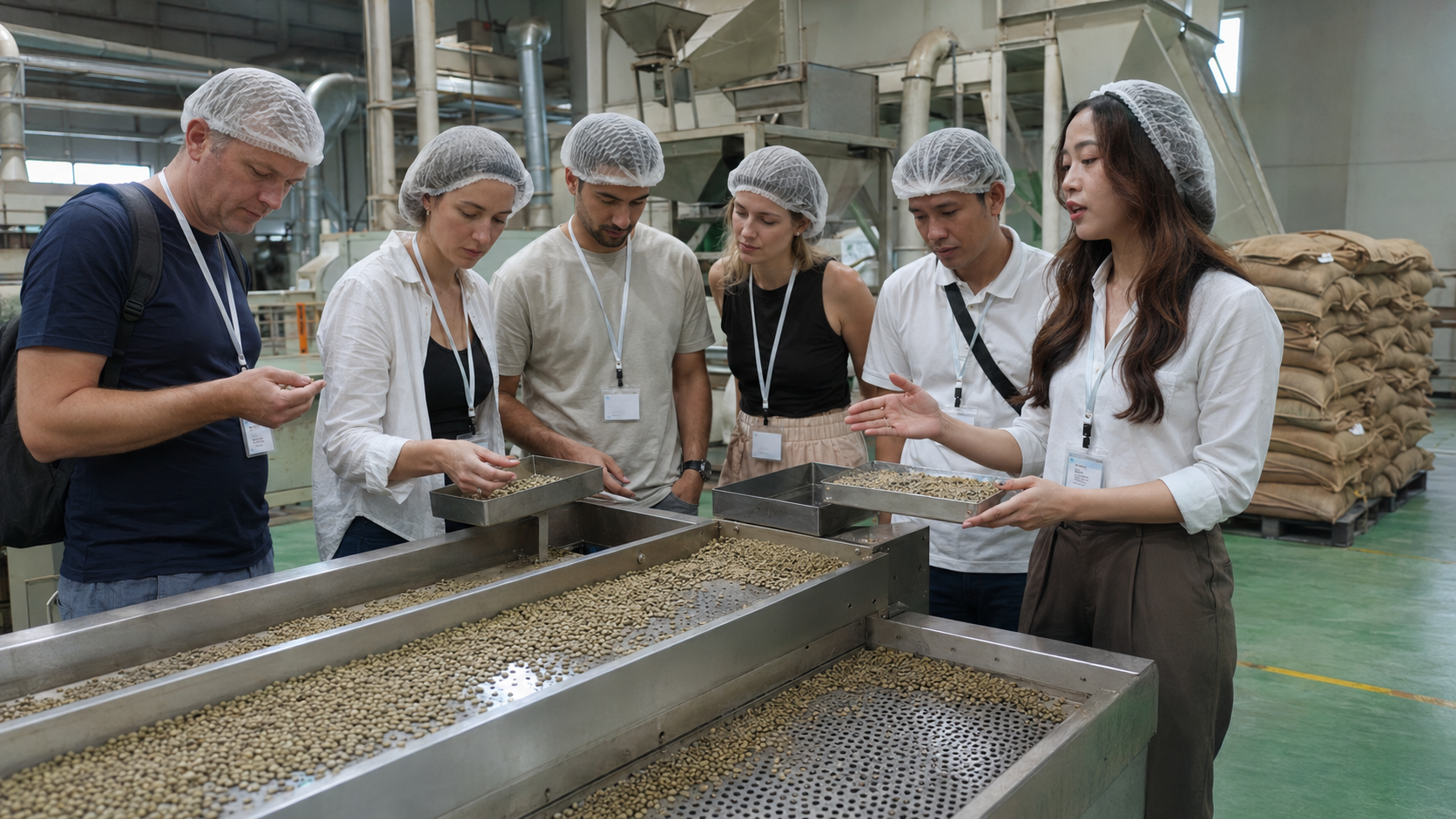
After receiving RFQ responses, narrow the list to the two or three suppliers who appear most capable of meeting your requirements. At this stage, the focus shifts from finding suppliers to verifying them. Verification covers legal registration, export licensing, facility observation, product capacity, and sample evaluation. This process is described in detail on the Vietnam coffee supplier verification page.
Running verification in parallel on two or three shortlisted suppliers means you have alternatives if one does not pass verification, and it gives you a comparison basis for making a more informed sourcing decision. Buyers who verify only one supplier at a time are vulnerable to delays if that supplier turns out not to be suitable — at which point the sourcing process has to restart from the beginning.
Step 5: Request Samples and Evaluate
Once you have completed verification for your shortlisted suppliers, request samples from those that pass. Samples should be representative of the product you intend to order — not a pre-selected showcase lot. Evaluating samples against your specification, and retaining approved samples as reference standards, is a critical step before placing a bulk order. Buyers are advised to document their sample evaluation in writing for each supplier.
Where samples from multiple suppliers are evaluated simultaneously, the process gives the buyer a direct comparison basis. The supplier whose sample best matches the specification — and who has passed verification — is the natural candidate for a trial order. The Vietnam coffee sample evaluation page explains this process in detail, including how Vietnam Biz Rep can coordinate sample collection in Vietnam.
Step 6: Place a Trial Order and Inspect
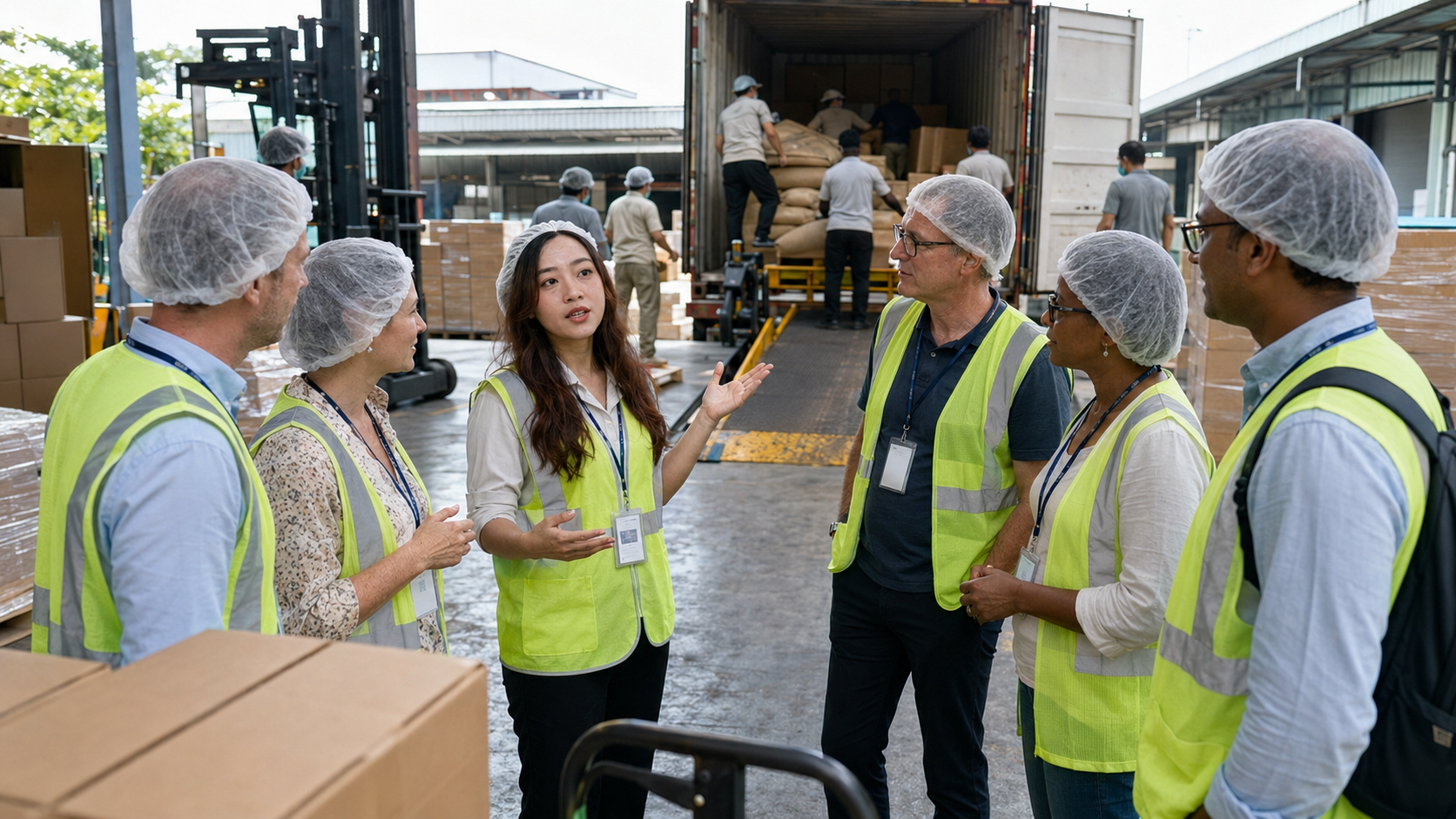
A trial order is the next step — a manageable commercial shipment that tests whether the supplier can perform at commercial scale. A trial order should be accompanied by a pre-shipment inspection to verify that the goods match the agreed specification before loading. Comparing the trial shipment against the approved sample gives the buyer an objective basis for assessing supplier performance on the first order.
If the trial order is satisfactory, subsequent orders can increase in volume with progressively more confidence. If problems emerge, the buyer has limited exposure and can address issues with the supplier from a position of documented evidence — what was agreed, what was inspected, and what arrived. For buyers managing ongoing supply relationships, the Vietnam sourcing agent service covers local representation throughout the supply cycle. General supplier verification principles apply across all stages of the process.
Common Mistakes When Searching for Coffee Suppliers
Experience across many sourcing engagements reveals several patterns that lead buyers into difficulty. One common mistake is engaging with only one supplier from the outset, without maintaining alternatives. If that supplier fails verification, proves unable to meet the specification, or experiences a production problem, the buyer has to restart the search from scratch — adding significant time and cost.
Another frequent error is focusing exclusively on price at the shortlisting stage. The lowest price quotation does not account for the risk that the supplier is unable to supply consistently at that price, that the product does not match the quoted specification, or that the supplier’s export operations are not sufficiently established. Evaluating suppliers on price, product suitability, communication quality, and verifiable business legitimacy gives a more complete picture.
A third common issue is proceeding to a large order without completing a trial order first. Trial orders are a standard practice in international sourcing precisely because they limit exposure during the period when the supply relationship is still being tested. Buyers who skip the trial order in the interest of speed or cost savings often find that problems discovered on a large order are far more expensive to resolve.
Frequently Asked Questions
How long does it take to find and onboard a new coffee supplier in Vietnam?
The timeline varies by product type, supplier availability, and the depth of verification the buyer requires. A realistic minimum for the full process — from initial search through RFQ, shortlisting, verification, sample evaluation, and a trial order — is typically two to four months. Buyers who compress this timeline by skipping verification or sample evaluation steps tend to encounter problems on the first or second order.
Can Vietnam Biz Rep find suppliers on my behalf?
Yes. Vietnam Biz Rep can support the supplier identification and shortlisting process as part of a local sourcing engagement. This includes identifying candidate suppliers who match the buyer’s specification, conducting initial outreach and RFQ coordination in Vietnamese, visiting shortlisted facilities, and reporting back to the buyer with observations and recommendations. The buyer makes the final sourcing decision based on Vietnam Biz Rep’s findings.
Are trade directories a reliable source for finding Vietnamese coffee suppliers?
Trade directories provide a starting point for identifying potential suppliers, but listing in a directory is not a verification of the company’s legitimacy or capability. Directory listings should be treated as an initial source of candidates, not as a validation of supplier quality or reliability. All suppliers identified through any channel — directories, trade shows, referrals — should go through verification before an order is placed.
What is the difference between a coffee exporter and a coffee processor in Vietnam?
A processor owns and operates processing facilities where green beans are hulled, sorted, and graded (or where roasting and grinding take place). An exporter handles the export transaction — obtaining export documentation, managing shipping, and dealing with trade compliance — but may not own processing facilities. Many companies in Vietnam operate as both. Understanding which type of entity you are dealing with affects what verification steps are most relevant and what production capacity claims should be checked.
To discuss how Vietnam Biz Rep can support your coffee supplier search in Vietnam, contact us with your product requirements and timeline.
