

Finding reliable coffee suppliers in Vietnam is only the first step. Before committing to a bulk order or a long-term supply relationship, overseas buyers need to carry out structured vietnam coffee supplier verification to confirm that a supplier is who they claim to be, operates as described, and can meet the specifications you require. This page explains what that verification process involves and how Vietnam Biz Rep supports buyers through each stage. Working with a local representative in Vietnam reduces the information gap that makes remote supplier assessment difficult, particularly when language, business culture, and regulatory systems are unfamiliar.

Why Supplier Verification Matters for Coffee Buyers
Vietnam is one of the world’s largest coffee-producing countries, and the supplier landscape is broad. It includes licensed exporters, processing companies, traders, cooperatives, and intermediaries. Not all of them operate transparently or consistently. Buyers who skip verification risk ordering from entities that misrepresent capacity, product type, certification status, or business registration.
Verification is not about distrust — it is about managing risk before money changes hands. A structured approach gives buyers the information they need to make an informed sourcing decision and builds a foundation for a repeatable supply relationship. For buyers at the early stage of building a shortlist, the Vietnam coffee suppliers overview explains the different supplier types active in the Vietnamese coffee market and the questions buyers should be asking before engaging.
Step 1: Legal Entity, Business Registration, and Export Licensing
The first layer of verification focuses on the supplier’s legal standing in Vietnam. This includes confirming that the company is registered with the relevant Vietnamese business registry, that its business registration number is active, and that the registered address matches what the supplier has provided to you. Discrepancies at this stage — between the stated address and the registered address, or between the company name on documents and the trading name — warrant clarification before going further.
Buyers should also check whether the company holds an export license that covers coffee products. While many Vietnamese companies can trade locally, only those with the appropriate export registration are legally permitted to ship internationally. Vietnam Biz Rep can assist with obtaining and reviewing these documents directly from official sources, comparing them against what the supplier has presented, and flagging inconsistencies for the buyer to follow up on.
Beyond registration, it is useful to check how long the company has been operating and whether the business scope listed in its registration matches the products being offered. A company registered for general trading that claims to process and export specialty Arabica coffee is a different proposition from a company with a long-operating coffee processing registration and documented export history.
Step 2: Product and Capacity Verification
Once legal standing is confirmed, the next step is verifying that the supplier actually handles the coffee product type you need. A company may list Robusta, Arabica, green beans, roasted coffee, or instant coffee on its website or in its catalogue, but buyers should confirm what is actually processed or traded at that facility versus sourced from third parties at the time of order.
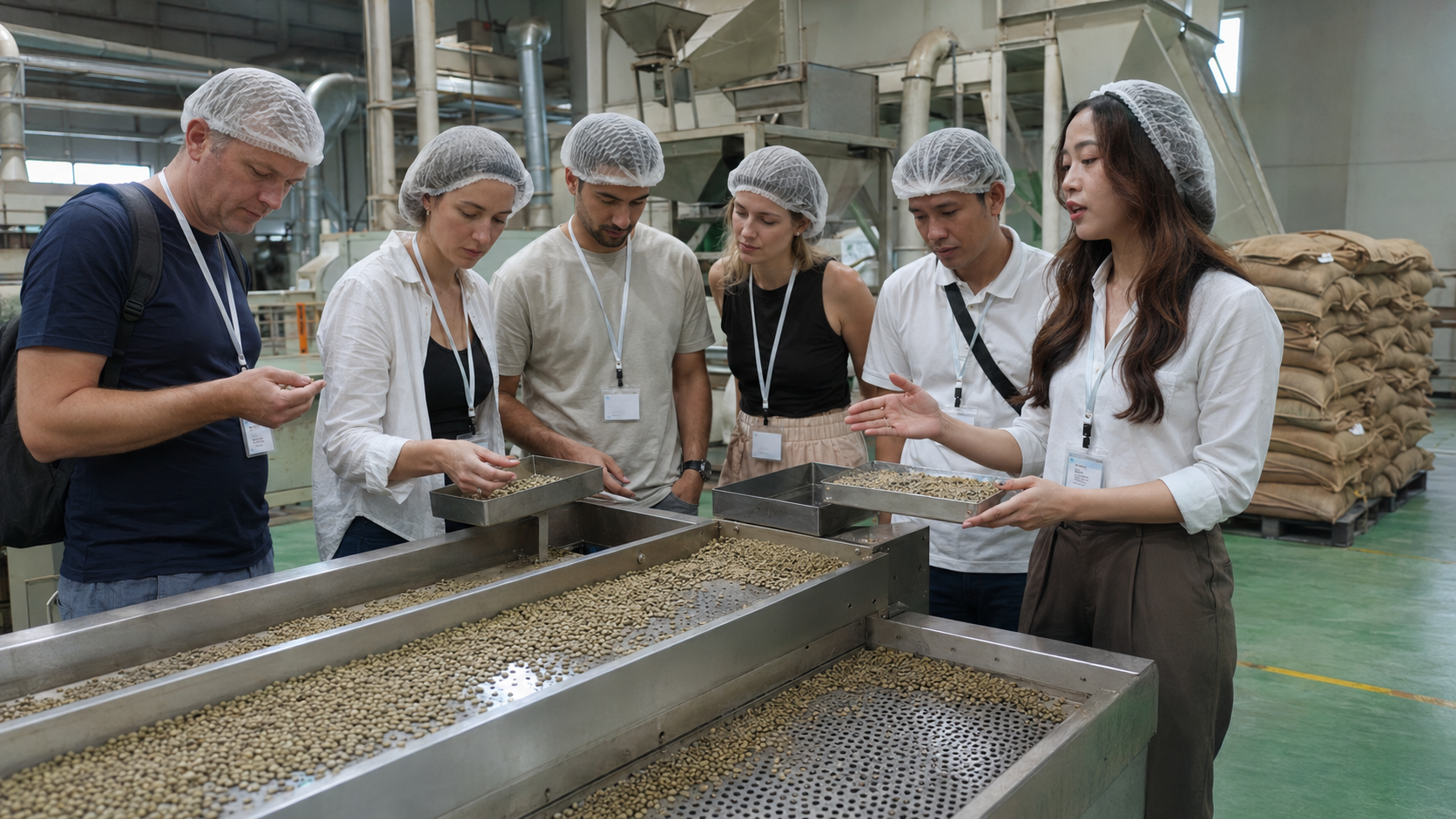
Capacity verification involves reviewing available production records, storage capacity, equipment, and recent export history where the supplier is willing to share it. This gives buyers a realistic picture of minimum order quantities and lead times without relying solely on verbal assurances. Vietnam Biz Rep can visit the facility on your behalf to observe operations and report back on what was seen during the visit — equipment type, approximate scale of operations, and storage conditions.
Capacity claims should be verified through observation rather than taken at face value. A supplier that claims to process 500 MT per month should be able to demonstrate this through equipment, staffing, and documented activity. If it cannot, that is material information for your sourcing decision. It is also worth identifying whether the supplier operates its own facility or relies primarily on subcontracting, as this affects quality consistency and lead time predictability.
Step 3: Product Specification Alignment and Document Review
Supplier verification also includes a review of whether the supplier can meet your specific product requirements. This is distinct from a quality inspection of a physical shipment — at this stage, you are evaluating whether the supplier understands your specification and has supplied similar products to other buyers on comparable terms.
Useful inputs include previous contracts or purchase orders (with sensitive data redacted), sample approval records, and any existing quality certificates the supplier holds. Buyers should request documentation relevant to their target market, whether that involves food safety requirements, organic certification, or other import conditions. Vietnam Biz Rep helps buyers prepare specification checklists and coordinates document review with the supplier on your behalf, following up in Vietnamese when needed to obtain clarifications.

Step 4: Facility Visit, Physical Observation, and Transaction History
Document review alone has limits. Visiting the supplier’s facility — or having a local representative do so — adds a layer of ground-level confirmation that cannot be replicated remotely. During a facility visit, the focus is on whether operations match what has been described in documents: whether the stated processing equipment is present and operational, whether the storage environment is appropriate for coffee, and whether hygiene and handling practices meet reasonable expectations for the product type.
Vietnam Biz Rep conducts facility visits on behalf of overseas buyers who cannot travel. The representative provides a written report of observations without making subjective quality judgments beyond what can be directly observed. This report helps buyers decide whether to proceed to sample evaluation, a more detailed factory audit, or further discussions with the supplier.
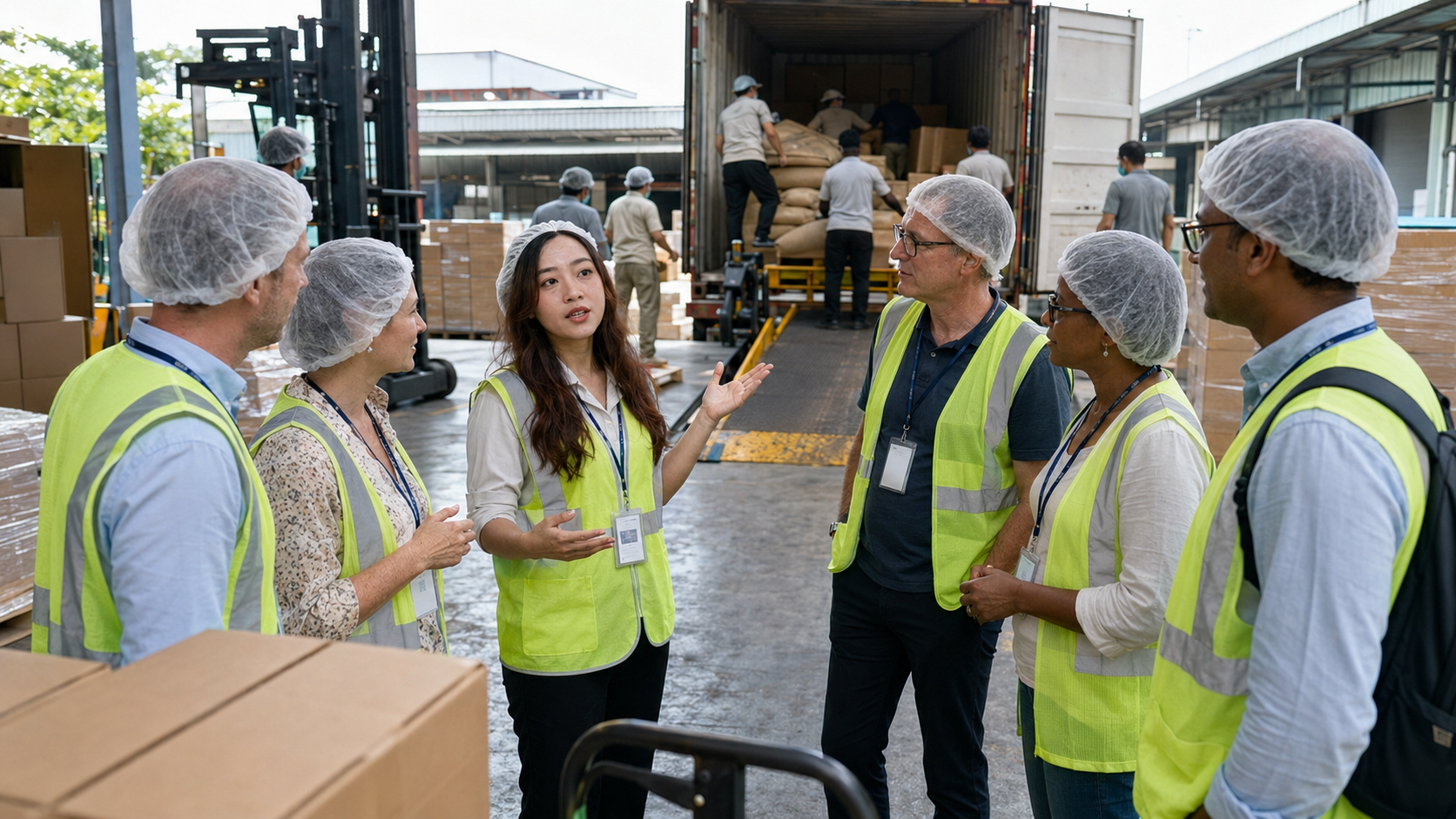
Where suppliers are willing to share it, reviewing past export records or providing trade references adds another dimension to verification. Export declarations, phytosanitary certificates issued against previous shipments, and bill of lading records give buyers a sense of whether the supplier has an active, functioning export operation. Reference checks with previous buyers are valuable where the supplier can facilitate them. For buyers who want a deeper technical review, a separate Vietnam coffee factory audit can be arranged to cover equipment condition, process controls, and documentation systems in greater detail.
How Vietnam Biz Rep Supports Supplier Verification
Vietnam Biz Rep acts as the buyer’s local representative throughout the verification process. This means coordinating document requests in Vietnamese, visiting facilities on the buyer’s behalf, cross-referencing business registry information, preparing observation reports, and communicating supplier responses back to the buyer in English.
This local presence reduces the information gap that overseas buyers face when working with suppliers in a different country and language. Rather than relying on supplier-provided materials alone, buyers gain an independent set of observations to inform their decision. Vietnam Biz Rep does not make sourcing decisions on behalf of buyers — the reports and findings are inputs to the buyer’s own evaluation.
Verification scope can be adjusted to match the buyer’s needs and the stage of the sourcing relationship. A basic check covers legal registration and a document review. A more comprehensive engagement includes a facility visit, product capacity assessment, and specification alignment review. Buyers can also combine verification with a Vietnam coffee quality inspection once a supplier relationship is established and a shipment is being prepared. For buyers building a full sourcing process from initial search through to order follow-up, the Vietnam sourcing agent services page explains how local representation can support the broader process. General supplier verification methodology applicable across industries is also available for reference.
Frequently Asked Questions
What documents should I request during coffee supplier verification in Vietnam?
Key documents include the supplier’s business registration certificate, export license, recent export records, product specification sheets, and any certificates relevant to your market (such as food safety, organic, or phytosanitary records). The relevance of each document depends on your product type and target market requirements.
Can Vietnam Biz Rep verify a supplier remotely without a site visit?
A partial verification can be conducted through document review and business registry checks without a physical visit. However, a site visit adds significant value by confirming that operations match what documents describe. For higher-value orders or new supplier relationships, an in-person visit is strongly advisable before committing to a large order.
How is supplier verification different from a factory audit?
Supplier verification focuses on legal standing, business identity, general capacity, and document review. A factory audit goes deeper into technical operations, equipment condition, process controls, and quality management systems. Verification is typically carried out before a formal audit is warranted and at lower cost.
What happens if a supplier fails verification?
Vietnam Biz Rep reports the findings to the buyer without making a pass/fail determination on their behalf. The buyer decides how to proceed based on the findings. Common outcomes include requesting additional documentation, arranging a follow-up visit, or removing the supplier from the shortlist and beginning the search again.
Does verification guarantee that a supplier will perform as expected?
No. Verification reduces risk by gathering available evidence at a point in time. It cannot guarantee future supplier performance, as circumstances can change. Ongoing quality inspection, pre-shipment checks, and regular communication with a local representative remain important throughout the supply relationship.
To discuss supplier verification requirements for your coffee sourcing project, contact Vietnam Biz Rep with details about the supplier you are evaluating and the product specification you are working with.
