

Overseas buyers sourcing Vietnam cashew kernel suppliers for wholesale, food manufacturing, or food service distribution face a complex supplier landscape with significant variation in product quality, processing capability, documentation readiness, and business transparency. Vietnam is a major global source of processed cashew kernels, and the country’s supplier market spans everything from large, well-equipped processing factories to smaller operations with limited export infrastructure. Understanding this landscape is essential before initiating an RFQ process.
Vietnam Biz Rep supports overseas buyers with local sourcing representation—helping buyers identify and verify cashew kernel suppliers, coordinate factory visits, review documentation, and manage buyer-side communication throughout the sourcing process. We do not sell cashew kernels and do not represent suppliers.

Cashew Kernel Grades and Product Forms
Vietnam cashew kernel suppliers offer processed kernels in multiple grades. The grading system is primarily based on count per pound (number of whole kernels per pound of product). Common white whole kernel grades include W180, W240, W320, W450, and W500. Lower counts indicate larger kernels; higher counts indicate smaller kernels. W320 and W240 are among the most traded grades internationally, though demand varies by market and application.
Beyond whole white kernels, suppliers may offer scorched whole (SW), splits (SP), scorched splits (SS), large pieces (LP), broken (B), butts/large brokens (BB), and small brokens (WB). Each grade has different price points, packaging requirements, and end-use applications. Food manufacturers using cashews as an ingredient often source broken grades for cost efficiency; retail and premium food service buyers typically require whole white kernels.
Buyers should note that grade definitions, moisture tolerances, defect allowances, and color specifications vary across buyers, contracts, and destination markets. There is no single universally applied standard—buyers should define their own specification in writing and confirm alignment with each shortlisted supplier before proceeding. Buyers should also confirm what internal quality testing the supplier conducts and what documentation they can provide to support grade claims.
Types of Vietnam Cashew Kernel Suppliers
Buyers sourcing Vietnam cashew kernel suppliers will encounter several distinct business types. Understanding these types is critical for determining which type of supplier is appropriate for your specific order profile.
Direct processing factories own or lease processing equipment, employ production workers, and process raw cashew nuts into kernels in-house. They typically offer the most direct path to understanding production quality and capacity, and they are generally the most appropriate supplier type for buyers who want to conduct factory audits. Their documentation capabilities vary—some operate sophisticated quality management systems while others have minimal documentation infrastructure.
Export trading companies source kernels from third-party processors, manage export logistics, and serve as commercial intermediaries. They may offer broader product ranges and more responsive commercial terms for smaller buyers, but they introduce supply chain opacity—buyers may not know which processing facility produced their product. For buyers with strict traceability requirements, this can be a limiting factor.
Cooperative or aggregation processors may source raw nuts from smallholder farms or multiple small processing units and centralize grading, sorting, and packaging. These entities can be viable suppliers for certain grades and volumes, but their production consistency may be more variable than larger integrated factories.
What to Verify Before Ordering from Vietnam Cashew Kernel Suppliers
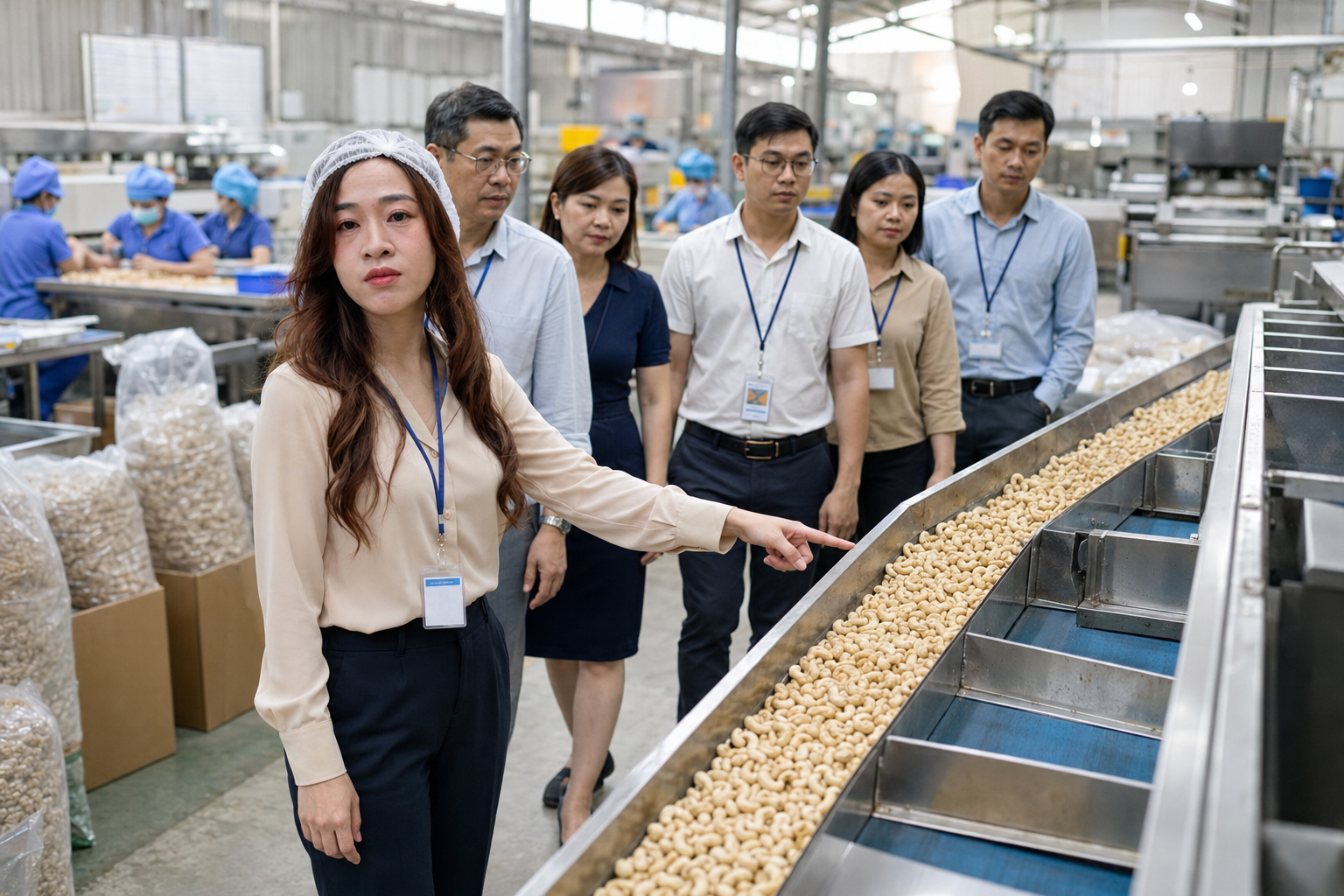
Before placing an order with any Vietnam cashew kernel supplier, buyers should conduct structured verification. The core verification steps include confirming the supplier’s business registration and enterprise code, export license status and validity, physical factory location (not just a head office), stated production capacity versus actual equipment and workforce, and the availability and accuracy of export documentation for the buyer’s destination market.
Beyond these foundational checks, buyers should also request a product specification data sheet from the supplier, review their packaging and labeling capabilities, and understand their internal quality testing procedures. Suppliers who are unable or unwilling to provide basic documentation are not ready for professional export relationships, regardless of competitive pricing.
Vietnam Biz Rep supports buyer verification as a standalone or integrated service. Our team conducts in-person checks that go beyond what remote due diligence can achieve—verifying physical factory locations, observing processing conditions, and reporting findings directly to the buyer. Learn more on our Vietnam supplier verification page.
Packaging and Documentation Considerations for Wholesale Buyers
Wholesale buyers of Vietnam cashew kernels typically require product in bulk format—vacuum-sealed inner bags packed in master cartons, or jumbo bags for food industry applications. Standard vacuum packaging helps preserve kernel quality during transit by limiting moisture and oxidation. Packaging specifications including bag material, vacuum level, net weight per inner bag, and carton configuration should be clearly defined in the buyer’s specification document.
Export documentation for cashew kernels typically includes a commercial invoice, packing list, bill of lading, certificate of origin, phytosanitary certificate, and quality certificate. Additional documents such as fumigation certificates, lab test reports, or food safety certificates may be required depending on the destination market and the buyer’s importer requirements. Buyers should confirm their specific documentation requirements with their importer, customs broker, or regulatory advisor before finalizing supplier selection—not all suppliers have the documentation systems to fulfill complex documentation requirements.
How Vietnam Biz Rep Supports Cashew Kernel Buyer Sourcing
Vietnam Biz Rep provides end-to-end buyer representation for overseas buyers sourcing Vietnam cashew kernel suppliers. Our support is structured to reduce the key risks buyers face when sourcing in Vietnam from overseas: supplier identity risk, quality consistency risk, documentation risk, and communication risk.
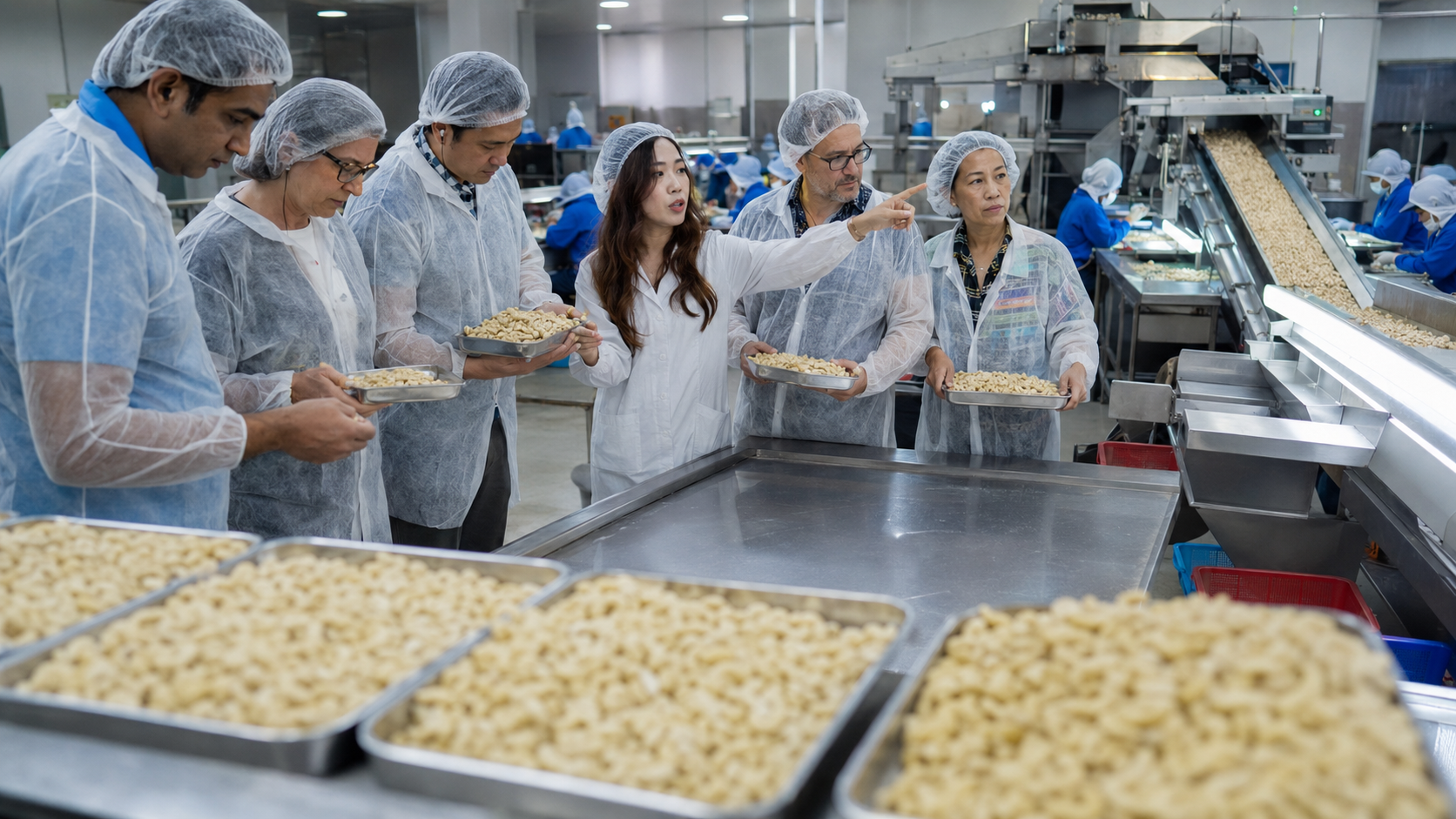
We identify and shortlist suppliers based on the buyer’s product specification and volume requirements, verify business registration and factory location in person, coordinate factory visits and audit support, facilitate sample requests and retained sample management, and support pre-shipment inspection coordination and document review. Throughout the process, we act as the buyer’s local communication liaison, managing follow-up and escalating issues to the buyer’s attention before they become shipment problems.
For buyers building ongoing procurement relationships in Vietnam, our Vietnam sourcing agent service provides a continuous buyer representation framework that covers multiple sourcing cycles. For buyers planning facility visits, our factory audit service provides structured assessment and buyer-ready reporting. For buyers needing quality checks on specific shipments, our Vietnam quality control support provides pre-shipment and in-process inspection coordination. For a broader overview of cashew sourcing in Vietnam, visit our Vietnam cashew nut suppliers page.

Frequently Asked Questions
What are the most commonly traded cashew kernel grades from Vietnam?
W320 and W240 are among the most widely traded grades from Vietnam. W180 and W450 are also available from many suppliers. Broken and split grades are available as well, primarily for food manufacturing applications. Grade availability and pricing depend on the specific supplier, season, and production run—buyers should confirm availability and specification with each shortlisted supplier.
Can Vietnam Biz Rep help identify suppliers for specific cashew kernel grades?
Yes. Buyers should provide a written product specification including grade, packaging type, net weight, and destination market requirements. This allows us to identify suppliers with relevant capabilities and to conduct verification that is relevant to the specific product and documentation requirements.
How many suppliers should a buyer shortlist before sending an RFQ?
For most sourcing exercises, three to five shortlisted suppliers provides a sufficient comparison basis. More suppliers create administrative complexity without proportionally increasing information quality. The goal is to find two or three verified, capable suppliers who can produce the required specification and provide complete documentation—not to collect the maximum number of quotations.
Does Vietnam Biz Rep guarantee supplier quality or product specification?
No. Vietnam Biz Rep provides buyer representation and verification support—we do not guarantee supplier performance, product quality, or shipment outcomes. Our role is to improve the quality of information available to the buyer before and during the sourcing process, reducing risk without eliminating it entirely.
Ready to start sourcing Vietnam cashew kernel suppliers with local support? Contact Vietnam Biz Rep to discuss your requirements and how we can help.
Checklist for First-Time Buyers of Vietnam Cashew Kernels
For buyers approaching Vietnam cashew kernel suppliers for the first time, the following checklist provides a practical framework for managing the sourcing process from initial contact to trial order shipment. This is not an exhaustive list, and buyers should adapt it to their specific product requirements and market regulations.
Before contacting suppliers: define your product specification in writing, confirm your volume requirement and packaging format, identify required export documents for your destination market, and set a realistic timeline accounting for sampling, verification, and production lead time. When contacting suppliers: send a structured RFQ with your written specification attached, ask for company registration documents and export license with initial response, and request a quote based on your specific specification rather than a general price list. After receiving quotations: compare responses on a like-for-like basis using your specification as the benchmark, identify the two or three strongest candidates, and engage a local representative or verification service to conduct in-person checks before proceeding. During sample stage: request samples clearly labeled with lot and date information, conduct sample evaluation against your specification, retain reference samples, and compare bulk production to retained samples via pre-shipment inspection. At shipment stage: confirm all required documentation is available and correct before releasing shipment funds, conduct or arrange pre-shipment inspection where possible, and keep records of all communication and documentation for each shipment.
